Free teaching guide · Grades 3–7 (ages 8–12)
Trapped in History
Book 1 · The Six Dials of Time · Become a time traveler!
Classroom reading over 3 to 4 weeks · 10 missions · about 6 sessions

Teacher’s guide
Learning goals
- Read an illustrated novel of more than 100 pages as a class and keep track of the story.
- Place six great ages of history on a timeline.
- Tell fiction apart from historical fact.
- Build vocabulary (12 words from the book) and write a text inspired by the story.
Lesson plan
Before reading (20 min)
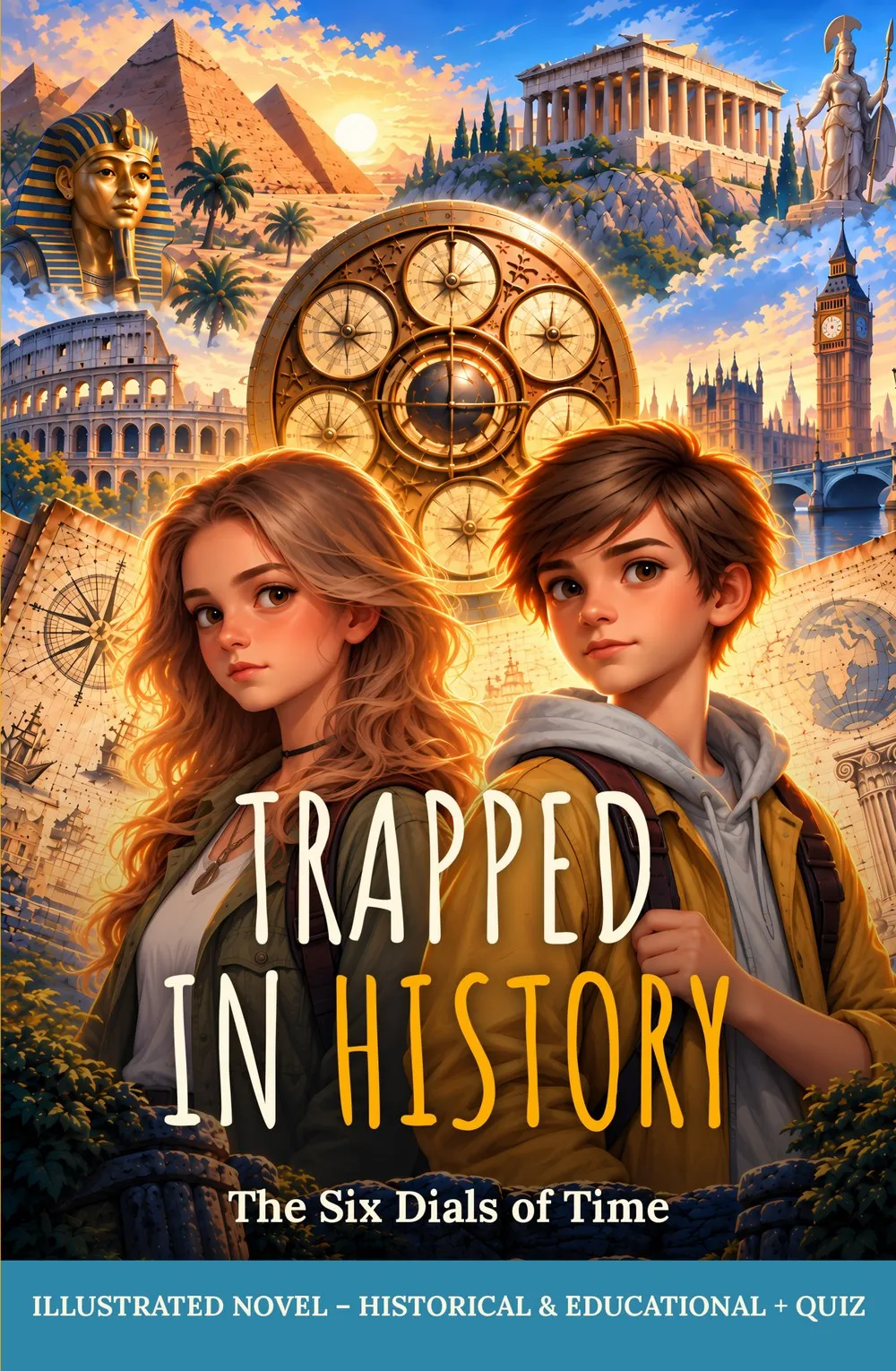
- Look at the cover: which monuments and which ages can you recognize?
- What is an astrolabe? Look for a picture and make some guesses.
During reading (one or two chapters per session)
- Read a chapter, then answer its question in the “traveler’s logbook” (mission 1).
- Fill in the timeline (mission 6) and the fragments (mission 2) as you go.
After reading (2 sessions)
- Games: who’s who, who said it, put it in order, word search.
- “True, false… or we don’t know?” with the notes at the end of the book, then a class debate.
- Creative writing, then the book’s quiz and the diploma.
Tips and discussion ideas
- Each mission fits on half a page: you can hand them out one at a time.
- The full answer key is at the end of this page (don’t print it for students).
- The book ends with “What’s true in this book” (pages 113-117), which separates the story from real history, and “Did you travel well?”, a 12-question quiz with answers (pages 118-121): perfect for a final assessment.
- Debate: Luca slows down in the race so he won’t change history, even though he was about to win. Would you have made the same choice?
- Debate: Nefer tells them never to say more than they need to, but Luca and Giulia tell the truth to Aspasia, Brother Basil, Leonardo and Montague to get their help. Is it right to tell the truth to get help?
- Debate: Montague and Margaret say science should belong to everyone, not only to noblemen and to men. What do you think?
Chapter by chapter (summaries and comprehension questions)
1. Poking about where you shouldn’t always ends badly (pp. 3-12)
On a school trip to the Egyptian Museum with their two classes, Giulia deciphers the inscriptions on an ancient astrolabe with six dials and turns its mechanisms. Luca has just taken a photo of it. As they put it back together, the astrolabe lights up, a whirl of light carries them off, and they land in ancient Egypt holding the frame of the astrolabe, without its six dials.
- Where are Luca and Giulia at the start of the story? → At the Egyptian Museum, on a school trip with their two classes.
- What do the six dials of the astrolabe stand for? → Six historical periods.
- Where do Luca and Giulia land after the whirl of light? → In ancient Egypt.
2. First fragment: the star disc of Tutankhamun (pp. 13-31)
Luca and Giulia bump into Nefer, a young Egyptian inventor whose family has studied journeys through time for generations. He tells them the first fragment is in Tutankhamun’s tomb, inside a pyramid. The two friends get past the sand trial, Giulia opens the last door with a hidden lever, and fitting the first dial sends them to ancient Greece.
- Who is Nefer? → A young Egyptian inventor whose family has studied time travel for generations.
- Where is the first fragment? → In Tutankhamun’s tomb, inside a pyramid.
- How does Giulia open the door to the tomb? → She presses a lever hidden in a small hole in the wall beside the door.
3. Second fragment: the celestial ring of the astronomer (pp. 32-47)
In ancient Greece, Aspasia takes the children home and gives them Greek clothes. To meet the astronomer Philippus, Luca has to win an event at the Olympic Games, so Aspasia’s son Demetrios trains him for two days. During the race the ground starts shaking: Luca slows down and finishes second. Philippus hands over the celestial ring, but he touches the astrolabe and travels on with them.
- Who takes Luca and Giulia home and gives them Greek clothes? → Aspasia.
- Why does Luca slow down during the race? → The ground started shaking under him: winning would have changed the past. He finishes second.
- What is the second fragment, and who made it? → A celestial ring engraved with constellations, made by Philippus.
4. Third fragment: the sextant of the senator (pp. 48-63)
In Rome, during the reign of Marcus Aurelius, the three travelers follow Senator Cornelius, who owns more sextants than any man in Rome, to his villa. With the children pretending to be Philippus’s apprentices, they get inside, but Cornelius wants to make the children his slaves and locks them in a cell. Philippus tricks the guards with an eclipse, they grab the sextant, and the third dial carries them to the Middle Ages.
- Which emperor is reigning in Rome during their visit? → Marcus Aurelius.
- What does Cornelius want to do with Luca and Giulia? → Make them his slaves.
- How does Philippus get the guards away from the cell? → He tells them an eclipse is about to happen and that their master wants them outside to see it.
5. Fourth fragment: the astronomical clock of the monk (pp. 64-79)
In the Middle Ages, a castle is under siege because a lord wants the monks’ stores of beer. Tristan, a young soldier running away from the fighting, leads the travelers inside. Giulia advises the general, Luca helps with the catapults until the ground shakes again, and the castle is saved. Brother Basil, keeper of the astronomical clock, finally lets them take it.
- Why is the castle under siege? → The lord wants to get his hands on the monks’ stores of beer.
- Who is Tristan? → A young enemy soldier who was running away from the siege and guides them into the castle.
- What is the fourth fragment, and who keeps it? → An astronomical clock, kept by Brother Basil.
6. Fifth fragment: Leonardo’s lens (pp. 80-93)
In Renaissance Florence, the travelers meet the young Leonardo da Vinci. His magnifying lens has been stolen by a group of children, and Luca and Giulia find it on a stall at the market. Philippus asks to stay in Florence as Leonardo’s apprentice; when the children hesitate, the ground shakes, so they agree, say goodbye and leave with the fifth dial.
- In which city do they meet Leonardo da Vinci? → In Florence.
- Who stole Leonardo’s lens, and where do Luca and Giulia find it? → A group of children; it is on a stall at the market.
- What does Philippus decide at the end of this chapter? → To stay in Florence as Leonardo da Vinci’s apprentice.
7. Sixth fragment: the star chronograph of the Royal Society (pp. 94-108)
In foggy Victorian London, Luca and Giulia meet Elias Montague, a young professor laughed at for his theories about time travel. With him and the librarian Margaret Whitmore, they sneak into the Royal Observatory at Greenwich. Giulia sets off an unfinished electrical experiment that blacks out the whole building, and Luca grabs the star chronograph.
- Who is Elias Montague? → A young professor and scientist who studies time travel and is laughed at by his colleagues.
- Where is the last fragment? → In the secret laboratory of the Royal Observatory at Greenwich.
- How does Giulia create a diversion? → She sets off an unfinished experiment in electrical energy, which causes a blackout across the whole building.
8. Back to the present: what do we have left? (pp. 109-112)
Luca and Giulia are back at the Egyptian Museum, at the very moment they left, wearing their own clothes and holding the complete astrolabe. They promise never to forget their journey. Luca now wants to learn history inside out, and Giulia wants to learn to invent.
- Where are Luca and Giulia at the end? → Back at the Egyptian Museum, with their class, their teacher and the guide.
- What do they notice about their clothes? → They are the ones they started in: plain tops, skirt, socks, jeans, sneakers.
- What won’t Luca miss? → Risking turning time upside down every five minutes and changing clothes all the time.
Student pages
Your missions
Name: ______________________ Date: ______________
Mission 1The traveler’s logbook
One question for each stage of the journey. Answer in one sentence.
1. Where are Luca and Giulia at the start of the story?
2. Who is Nefer?
3. Who takes Luca and Giulia home and gives them Greek clothes?
4. Which emperor is reigning in Rome during their visit?
5. Why is the castle under siege?
6. In which city do they meet Leonardo da Vinci?
7. Who is Elias Montague?
8. Where are Luca and Giulia at the end?
Mission 2Match each age to its fragment
Match each age with the piece of the astrolabe found there.
Mission 3Who’s who?
Match each character with their description.
Mission 4Who said it?
Find the character who says each of these lines from the book.
1. “Poking about where you shouldn’t always ends badly”
Who is speaking?
2. “Only a madman or one chosen by the gods could recover them all”
Who is speaking?
3. “It isn’t only your body that competes. It’s your spirit too.”
Who is speaking?
4. “Despite being a mind superior to all others, I am still human.”
Who is speaking?
5. “I am a man of business, and I see a great deal more value in you as slaves than as scientists”
Who is speaking?
6. “Take it with you. But never forget where it came from”
Who is speaking?
7. “Let’s not exaggerate. I’m still studying”
Who is speaking?
8. “Science belongs to everyone.”
Who is speaking?
9. “I’m tired of living in the shadow of noblemen and of men.”
Who is speaking?
- Possible characters: Luca · Nefer · Demetrios · Philippus · Cornelius · Brother Basil · Leonardo da Vinci · Elias Montague · Margaret Whitmore
Mission 5Put the journey in order
Number the stages from 1 to 6.
- In London, they take the star chronograph from Greenwich, then go back to the museum.
- In the Middle Ages, they help defend the castle, and Brother Basil gives them the clock.
- At the museum, the astrolabe carries Luca and Giulia off to ancient Egypt, where Nefer helps them.
- In Florence, they get the lens back, and Philippus stays with Leonardo da Vinci.
- In Rome, they escape from Senator Cornelius’s villa with the sextant.
- In Greece, Luca slows down in his race and finishes second, then Philippus follows them.
Mission 6The timeline
Place each stage of the journey under its date.
To place: Florence and the young Leonardo · The castle under siege · Tutankhamun’s Egypt · London and Greenwich · Rome under Marcus Aurelius · The Olympic Games in Greece
Mission 7The traveler’s words
Find the 12 words from the book hidden in the grid (across, down or diagonally).
| E | M | C | A | T | A | P | U | L | T | F | M |
| C | T | F | R | A | G | M | E | N | T | O | E |
| L | L | K | M | S | E | X | T | A | N | T | O |
| I | J | D | I | A | L | I | O | I | R | D | E |
| P | V | U | M | O | N | A | S | T | E | R | Y |
| S | H | F | K | I | E | D | J | L | V | M | M |
| E | C | A | A | E | S | L | A | V | E | E | O |
| A | S | T | R | O | L | A | B | E | L | U | J |
| A | L | L | C | A | N | S | C | R | O | L | L |
| F | F | E | B | N | O | I | S | I | E | G | E |
| H | D | K | N | E | S | H | C | T | U | J | E |
| P | B | R | B | S | A | H | V | A | V | N | G |
- ASTROLABEAn old instrument used to observe the stars and the sky.
- PHARAOHA king of ancient Egypt.
- DIALA round face with marks on it, like the face of a clock.
- FRAGMENTA small piece of something.
- SEXTANTAn instrument that measures how high a star is, to help sailors find their way.
- ECLIPSEWhen the Moon blocks all or part of the Sun, or moves into Earth’s shadow.
- SIEGEAn attack where an army surrounds a castle or a town.
- CATAPULTA war machine that throws big rocks.
- MONASTERYA place where monks live and work.
- SCROLLA long sheet of paper or parchment with writing on it, rolled up into a tube.
- SLAVEA person who is not free and is forced to work for a master.
- LENSA curved piece of glass that makes things look bigger or clearer.
Mission 8True, false… or we don’t know?
Check a box, then look up the answer in “What’s true in this book,” at the end of the novel.
Tutankhamun became pharaoh when he was about nine years old.
TrueFalseWe don’t know
Tutankhamun was buried inside a pyramid.
TrueFalseWe don’t know
The pyramids were built by slaves under the whip.
TrueFalseWe don’t know
Winners at the ancient Olympic Games received a gold medal.
TrueFalseWe don’t know
The Romans used sextants.
TrueFalseWe don’t know
A monk really did design an astronomical clock.
TrueFalseWe don’t know
The woman in the Mona Lisa was Lisa Gherardini.
TrueFalseWe don’t know
Women were allowed to join the Royal Society from the very start.
TrueFalseWe don’t know
Mission 9Your turn to write
Write a page from Philippus’s diary, now that he is Leonardo da Vinci’s apprentice in Florence.
Mission 10Your turn to invent
Imagine a seventh age and a seventh dial: where would you go, who would help you, and what fragment would you have to find?
Time Traveler Diploma
This diploma is awarded to
who traveled through six ages with Luca and Giulia and found the six fragments of the astrolabe… without changing the past!
Date ______ / ______ / ________ · Signature: ________________
For the teacher
Answer key
The answer key is waiting for you
Enter your email address to see it, print the guide and get it as a PDF. It’s free.
Mission 1The traveler’s logbook
One question for each stage of the journey. Answer in one sentence.
1. Where are Luca and Giulia at the start of the story?
At the Egyptian Museum, on a school trip with their two classes.
2. Who is Nefer?
A young Egyptian inventor whose family has studied time travel for generations.
3. Who takes Luca and Giulia home and gives them Greek clothes?
Aspasia.
4. Which emperor is reigning in Rome during their visit?
Marcus Aurelius.
5. Why is the castle under siege?
The lord wants to get his hands on the monks’ stores of beer.
6. In which city do they meet Leonardo da Vinci?
In Florence.
7. Who is Elias Montague?
A young professor and scientist who studies time travel and is laughed at by his colleagues.
8. Where are Luca and Giulia at the end?
Back at the Egyptian Museum, with their class, their teacher and the guide.
Mission 2Match each age to its fragment
Match each age with the piece of the astrolabe found there.
- Ancient Egypt → The star disc of Tutankhamun
- Ancient Greece → The celestial ring
- The Roman Empire → The sextant
- The Middle Ages → The astronomical clock
- The Renaissance → Leonardo’s lens
- The Victorian Age → The star chronograph
Mission 3Who’s who?
Match each character with their description.
- Nefer → Young Egyptian inventor who helps them
- Aspasia → Greek woman who takes the children in
- Demetrios → Aspasia’s son, a runner who trains Luca
- Philippus → Odd Greek astronomer who travels with them
- Cornelius → Haughty senator who wants slaves
- Tristan → Young soldier running away from the siege
- Brother Basil → Monk who brews beer, keeper of the clock
- Leonardo da Vinci → Young scholar and inventor in Florence
Mission 4Who said it?
Find the character who says each of these lines from the book.
1. “Poking about where you shouldn’t always ends badly”
→ Luca
2. “Only a madman or one chosen by the gods could recover them all”
→ Nefer
3. “It isn’t only your body that competes. It’s your spirit too.”
→ Demetrios
4. “Despite being a mind superior to all others, I am still human.”
→ Philippus
5. “I am a man of business, and I see a great deal more value in you as slaves than as scientists”
→ Cornelius
6. “Take it with you. But never forget where it came from”
→ Brother Basil
7. “Let’s not exaggerate. I’m still studying”
→ Leonardo da Vinci
8. “Science belongs to everyone.”
→ Elias Montague
9. “I’m tired of living in the shadow of noblemen and of men.”
→ Margaret Whitmore
Mission 5Put the journey in order
Number the stages from 1 to 6.
- 1At the museum, the astrolabe carries Luca and Giulia off to ancient Egypt, where Nefer helps them.
- 2In Greece, Luca slows down in his race and finishes second, then Philippus follows them.
- 3In Rome, they escape from Senator Cornelius’s villa with the sextant.
- 4In the Middle Ages, they help defend the castle, and Brother Basil gives them the clock.
- 5In Florence, they get the lens back, and Philippus stays with Leonardo da Vinci.
- 6In London, they take the star chronograph from Greenwich, then go back to the museum.
Mission 6The timeline
Place each stage of the journey under its date.
Mission 7The traveler’s words
Find the 12 words from the book hidden in the grid (across, down or diagonally).
| E | M | C | A | T | A | P | U | L | T | F | M |
| C | T | F | R | A | G | M | E | N | T | O | E |
| L | L | K | M | S | E | X | T | A | N | T | O |
| I | J | D | I | A | L | I | O | I | R | D | E |
| P | V | U | M | O | N | A | S | T | E | R | Y |
| S | H | F | K | I | E | D | J | L | V | M | M |
| E | C | A | A | E | S | L | A | V | E | E | O |
| A | S | T | R | O | L | A | B | E | L | U | J |
| A | L | L | C | A | N | S | C | R | O | L | L |
| F | F | E | B | N | O | I | S | I | E | G | E |
| H | D | K | N | E | S | H | C | T | U | J | E |
| P | B | R | B | S | A | H | V | A | V | N | G |
- ASTROLABEAn old instrument used to observe the stars and the sky.
- PHARAOHA king of ancient Egypt.
- DIALA round face with marks on it, like the face of a clock.
- FRAGMENTA small piece of something.
- SEXTANTAn instrument that measures how high a star is, to help sailors find their way.
- ECLIPSEWhen the Moon blocks all or part of the Sun, or moves into Earth’s shadow.
- SIEGEAn attack where an army surrounds a castle or a town.
- CATAPULTA war machine that throws big rocks.
- MONASTERYA place where monks live and work.
- SCROLLA long sheet of paper or parchment with writing on it, rolled up into a tube.
- SLAVEA person who is not free and is forced to work for a master.
- LENSA curved piece of glass that makes things look bigger or clearer.
Mission 8True, false… or we don’t know?
Check a box, then look up the answer in “What’s true in this book,” at the end of the novel.
Tutankhamun became pharaoh when he was about nine years old.
True – He died at about nineteen. His tomb was discovered in 1922 by the archaeologist Howard Carter.
Tutankhamun was buried inside a pyramid.
False – He was buried in the Valley of the Kings, in a tomb dug into the rock. The pyramids of Giza are more than a thousand years older than him.
The pyramids were built by slaves under the whip.
False – Most of the builders were paid workers who also received rations of bread and beer. Archaeologists have found the village where they lived.
Winners at the ancient Olympic Games received a gold medal.
False – They received a crown of olive leaves.
The Romans used sextants.
False – The sextant was invented in the eighteenth century. The Romans measured time with sundials and water clocks.
A monk really did design an astronomical clock.
True – Richard of Wallingford, abbot of St. Albans in England, designed one around 1330.
The woman in the Mona Lisa was Lisa Gherardini.
We don’t know – The book says she is “thought to be” Lisa Gherardini, the wife of a Florentine merchant: very likely, but not certain.
Women were allowed to join the Royal Society from the very start.
False – The Royal Society was founded in 1660, but it only elected its first women Fellows in 1945.