
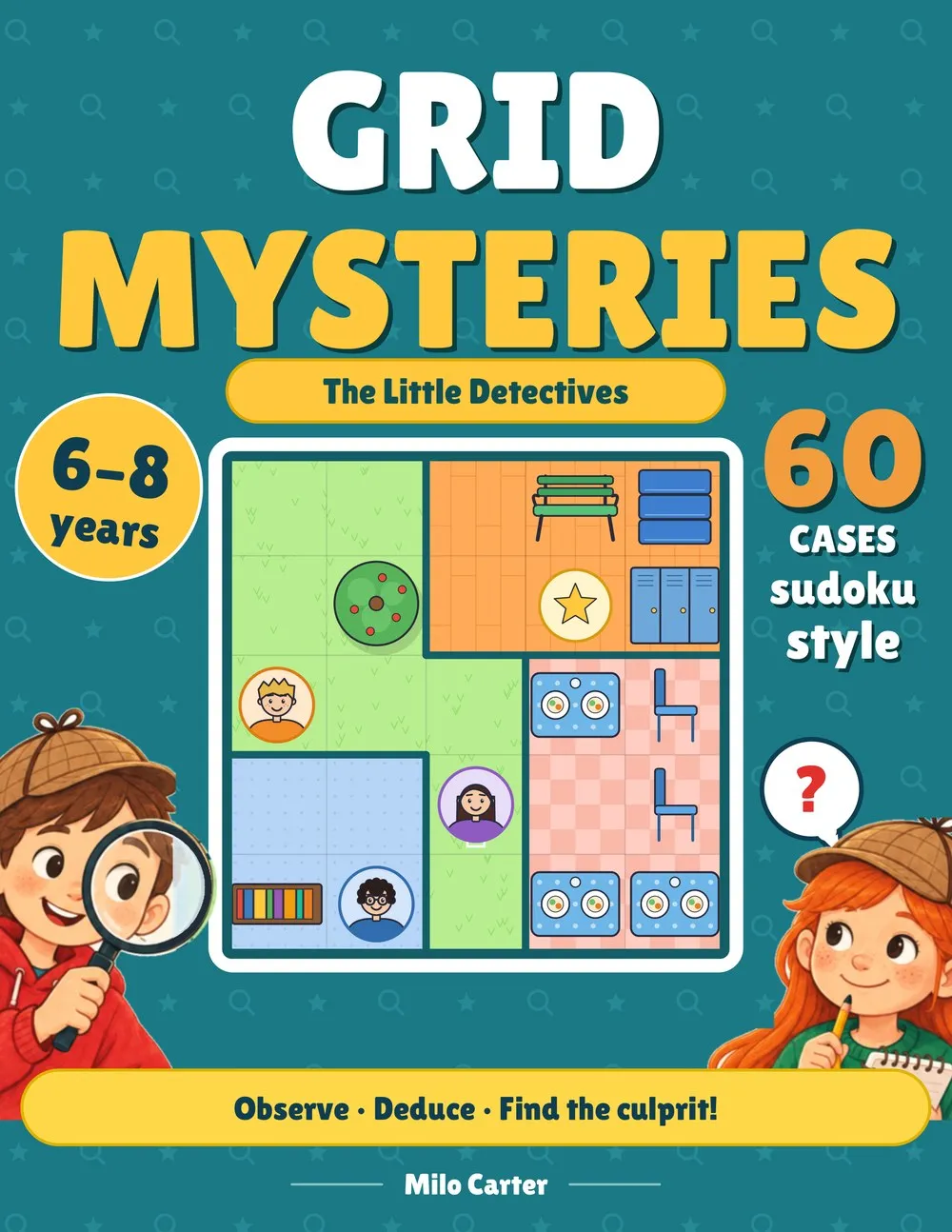
At 6 or 7, lots of children love playing detective. They look for footprints, blame the cat and question the whole family. It’s a wonderful way into logic, as long as you give them a playground where every clue counts.
That’s the idea behind grid mysteries, the cases we publish in Grid Mysteries. Here is how they work, and how to help a child who is trying one for the very first time.
How it works
Something has gone missing. A pencil case, a snack, the school’s soccer trophy. On the map of a school or a house, divided into squares like a little sudoku, the child places the suspects and the missing object by following the clues. The culprit is the only suspect who was in the same area as the object.
There is nothing to guess. If the child follows the clues in the right order, each token has only one possible square.
The rules, in short
There are five, and they are the same for every case.
- Only one token per row and per column, just like sudoku.
- No token can go on a big piece of furniture or a tree: a desk, a bookshelf, a table… An empty square, on the other hand, can always be used.
- You can use these squares: a chair, a beanbag, a rug, a bench, a hopscotch grid or a gym mat.
- “Next to” means right above, below, to the left or to the right. Squares that touch only at a corner don’t count, and it even works on the other side of a wall!
- The culprit is the only person who was in the same area as the missing object. The areas are separated by thick walls.
Rule 4 usually needs a little explaining. We suggest showing it with your finger on the grid before you start.
A first case, step by step
Let’s take the teacher’s pencil case, case #1 in the book, which was also our very first puzzle of the week to play online. Four tokens: Max, Leo, Zoe and the pencil case.
Always start with the clue that leaves only one possibility. “Max was reading on a beanbag.” There is only one beanbag on the map, on D1. Max goes there.
Same reasoning for Zoe, who “was sitting on a chair”: there is only one, on A3.
Leo “was right next to a table.” Three squares work: A3, B1 or B2. A3 is already taken by Zoe. B1 is in Max’s row. That leaves B2.
As for the pencil case, which was right next to a bookshelf, only one square is still free once the other rows and columns are taken: C4. It’s on the playground. And who else is on the playground? Leo, and only Leo.
That last step is what gives meaning to all the others: every token placed was there to single out the culprit.
How to help
Make it hands-on. Counters, bottle caps or the tokens to cut out from the book help the youngest ones enormously: you put one down, take it away, try something else.
Ask them to explain out loud. “Max goes there because…” is worth just as much as the right answer, and it’s where you can see whether the row-and-column rule has really sunk in.
Tip
A trick that works well: lay a strip of paper over the row and the column of each token you place. The off-limits squares jump out, and the grid gets simpler before your eyes. The book even has “Do Not Cross” strips ready to cut out for exactly this.
Resist the urge to give the answer. A single question is often enough to get them unstuck: “Which character could we start with?” In the book, every case has a small hint printed upside down at the bottom of the page, precisely so the child searches first.
Finally, make it harder slowly. 4×4 grids are plenty at the start. The 5×5 and 6×6 grids can wait until the child places the first tokens without hesitating.
What your child is practicing without noticing
Reading a short instruction carefully. Finding a square in a grid, with its columns A, B, C and its rows 1, 2, 3. The words for position and space. And above all, reasoning by elimination, a skill that goes far beyond games.
For the classroom, our free teaching guide uses this same case with grid-reading exercises, a “right next to it” game, a blank grid for making up your own case and a Super Detective diploma. And if your child asks for more, a new puzzle of the week arrives every Wednesday, and the book, Grid Mysteries – The Little Detectives, holds 60 cases.